Tea Company Connects Springfield With Northern India
A local entrepreneur and University of Oregon graduate has established a tea importing business in Springfield. This unique company works directly with tea farmers in India and is aimed at supporting rural communities. He founded this mission driven business to address international tea labor issues. KLCC’s Corinne Boyer has this story.
In an office above the Public House in Springfield, sit dozens of large brown sacks of tea. Pinned to a wall is a West Bengal Tourist map of India. That’s because this tea was grown, produced and then shipped from gardens in the Kumaon region of Northern India. This is Young Mountain Tea, where Raj Vable directly imports tea from Indian farmers. Vable was working on a Fulbright fellowship and wanted to get out of the electrical engineering field. So he found another way to create jobs at the foot of the Indian Himalayas.
Vable: And so by working directly with the communities, and by linking these communities up with world renowned producers across the world, we’re able to raise the quality and make sure that the money that gets earned from the sale of the tea stays in the hands of the people who actually do the hard work of growing it.
Indian tea farmers are usually paid about ten cents per pound Vable says. Then its sold in the U.S. for around $80 per pound.
Vable: So that’s an 80,000 percent markup between the producer and the consumer.
So what we’re able to do is leverage that incredible margin to not only pay the farmer more but then also develop a viable business.
Vable brews a cup of white tea.
Vable: My favorite tea is white tea--what we are drinking right now. It’s just so gentle and balanced. This particular tea is from our star producer Desmond Birkbeck in the northern part of India. And it was his first time making this tea.
Birkbeck is a third generation tea grower from the town of Champawat. Via Skype he points out the scenery at the planation started by his grandfather. It’s monsoon season so the trees, bushes and greenery are vibrant and cover every inch of the hilly backdrop.
Birkbeck: So now tea is my passion, so I thought ok fine if there’s somebody interested in tea then why not. And suddenly Raj pops up and he says can you make this kind of tea. It’s the first time that I’m looking at the white tea he has in his hands, and I said ok fine I looked at it, smelled the tea, and I said well if somebody has made it why can’t we make it.
Birkbeck oversees approximately 500 acres of tea plants. Since working with Young Mountain Tea, Birkbeck says his production has doubled. In turn, the growing tea gardens have created more jobs in a rural area with limited opportunities.
Birkbeck: A lot of young aspiring Indians want to come to the states to work there. Similarly up here in the hills, all these young boys will study a little bit and then they want to go down to the plains or the cities to work.
Mission-driven businesses like Young Mountain Tea are common in the Eugene/Springfield area and in the state. That’s according to University of Oregon food studies professor Stephen Wooten. He says businesses are using food, whether its wine, cheese, or power shakes, as a way to do business and build community.
Wooten: I think our community, the Eugene Springfield community, has a lot going on in terms of entrepreneurial activity driven by profit, but it’s also driven by a kind of commitment to people and the planet as well.
Raj Vable says he sees Young Mountain Tea Company as an experiment allowing different cultures to work together for the common good.
Vable: I’m the son of Indian immigrants. I really think that the values that both cultures have present a really exciting way to addresses some of the problems that we are facing.
Tea grower Desmond Birkbeck says now there are 428 people working in Champawat. And he hopes that that more people in the states will drink tea.

How One Oregon Jail Is Using Yoga Classes To Address Trauma
For a number of years, yoga classes have been offered in prisons. The Lincoln County Jail is now offering classes for its short stay inmates. When the jail psychologist was challenged with recent budget cuts, he started the volunteer run program addressing stress, anxiety and trauma. KLCC’s Corinne Boyer has this story from the jail.
Eight women dressed in orange jumpsuits file into the jail’s library. Filing cabinets, tables and chairs have been moved along the walls to make room for yoga mats, blocks and towels. Tiny windows close to the ceiling allow some sunlight to enter the fluorescent-lit cinder block room. The women begin the class by spinal rocking. They move into mountain pose.”
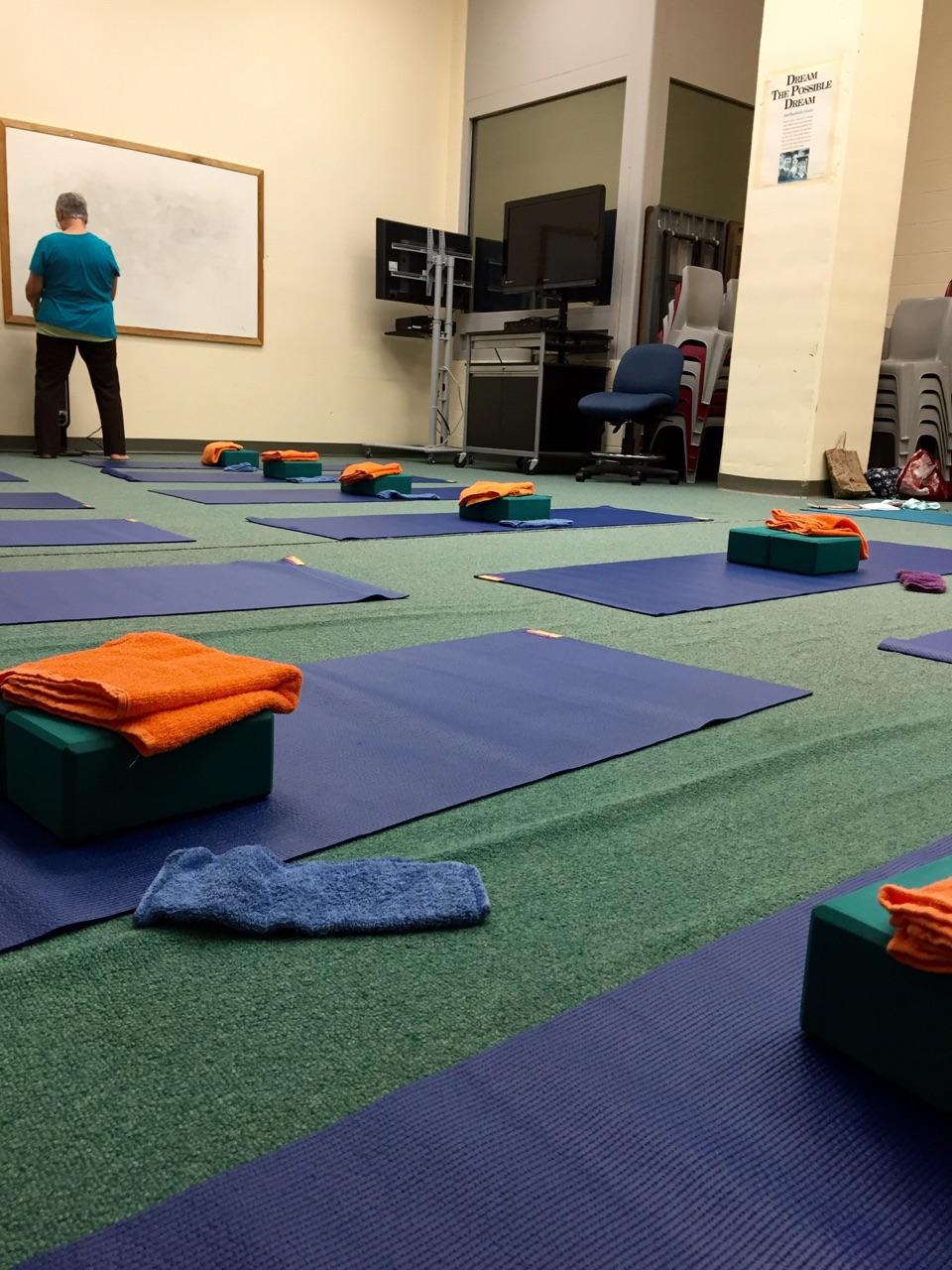
Sally Cheney prepares to teach a yoga class at the Lincoln County Jail.
“My name is Emiko. This is my fourth week of coming and it’s amazing. When I first came in, a lot of the girls were seasoned so I felt a little out of place, but the teacher is just amazingly patient and she walks us all through it. If there’s things going on outside of this room, it tends to stay at that door and it doesn’t come in here.”
Dennis Buckmaster is the Lincoln County Jail counselor. He says more than 60 percent of inmates have a mental disorder or mental issues caused by trauma.
Buckmaster: “When I first working here at the jail, I thought we need an exercise class, we need a yoga class, we need something. And I ran into Sally and I’m so glad that she said yes.”
Cheney: “I’m Sally Cheney. I've been teaching yoga for about 25 years. And I've taught many different populations from developmentally disabled, Down's syndrome, high school kids in drug rehab, the blind and a regular population of people.”
The 71 year old didn’t hesitate when asked to teach inmates.
Cheney: “It’s been really rewarding for me just because the feedback I get is so positive and I've notice that the inmates are anxious to have more things to do.”
“I’m Marcy.”
Boyer: “And how does yoga make you feel?”
Marcy: “All my tension goes, it’s good for my mind body and soul. I feel so much at peace out there when it’s really noisy. I think everybody should do it. And Sally is beautiful. When you walk in, you can feel her, you don’t even have to touch her.”
For many of the women this is their first yoga experience. Today they’re holding each pose for eight breaths. Paulette Bartley helps the inmates transition into warrior 1. She says a lot of women have issues when they arrive.
Bartley: “There’s a lot of people in the jails that have ADHD or fetal alcohol or any number of things that have happened to them that’s not their fault. And I can see that gradually as they do the yoga, those symptoms calm down.”
Recruiting volunteers was easier than getting the corrections staff on board. Buckmaster had to prove the yoga classes were beneficial so he counted up the number of incidents from arguments to fist fights. After the first class he saw a significant reduction.
Buckmaster: “The corrections officers that deal with them on a daily basis have seen a benefit in the behavior. The trauma doesn’t go away, but they’re learning how to manage it. They aren’t relying on something outside of them to do it. They’re learning from this class how to manage their body and their feelings.”
Marcy practices yoga one hour a day in her cell. She doesn’t like the way she feels if she skips a day. Marcy and Emiko plan to take classes when they leave the Lincoln County Jail. The women relax in corpse pose as the class comes to an end. Instructor Cheney says with yoga we can have a higher regard for ourselves and how we live our lives.

The yoga classes are held in the jail's library.
Photo Credits Corinne Boyer

Olive Ridley Turtle Continues Recovering At SeaWorld
In December 2014, a tropical sea turtle was discovered by a couple on a Washington Beach. The olive ridley turtle drifted over a thousand miles north from her native waters off the Mexican coast. Hypothermic, emaciated and near death, the reptile was transported to the Oregon Coast Aquarium in Newport for rehabilitation. In February, the U.S. Coast Guard flew Solstice to SeaWorld San Diego. KLCC’s Corinne Boyer traveled to San Diego to see how Solstice was doing.
When Solstice arrived at SeaWorld, she was outdoors in the park’s rehabilitation area in a pool by herself. Now the olive ridley turtle is inside an aquarium with two other rescued turtles. She swims over to rest on the rocks as we stand above the 12 foot deep tank.
Solstice, an olive ridley turtle, resting in her tank at SeaWorld.
CREDIT CORINNE BOYER
Mike Price: “My name is Mike Price. I’m assistant curator of fishes here at SeaWorld San Diego. I’ve been with the park for 20 years. Currently, I help manage the team that takes care of the sharks, sea turtles and fishes in the park."
Boyer: “And can you tell me about Solstice and how you’ve been taking care of her?”
Price: “So her current weight is 51 pounds and for her that’s a pretty good size. Olive ridleys don’t get much bigger than 80 or so. Olive ridleys will happily eat whatever they get. Right now she gets two or three different types of fish plus clam. We like that because it’s a variety—in the same way I’m not only allowed to eat cheeseburgers—a variety is healthier.”
Solstice has access to a veterinarian and a team of caretakers. She recently had a CT scan which was used to try and understand her buoyancy problem.
Price: “The minute she stops swimming with her flippers she’ll pop back up to the surface like a cork. So what we’ll do just like with a sports injury like a rehabilitative process on your leg or arm, we will continue to allow her to work those muscles give her more options for diving down into depth.”
Price says Solstice was moved from the Oregon Coast Aquarium to SeaWorld because US Marine Fisheries requires all species of endangered sea turtles to be rehabilitated at SeaWorld. Ideally, Solstice will be moved back outside to continue her recovery, but currently every bit of space is filled with sea lion pups.
Steve Dunning: “My name is Steve Dunning. I’m one of the senior animal care specialists here. Right now we’re looking at just over 300 animals in the park right now. Our numbers are actually over 500. So this is a very unusual event right now.”
Boyer: “Why are there so many sea lion pups?”
Dunning: “What we are seeing this year is an event where those inshore fishes are not available to them. So they’ve got to travel further and in deeper water, but they don’t have the strength. But this year it seems like the fish are even further north, the water’s warmer--it’s possibly a pretty strong El Nino event."
Solstice floats on the water's surface because of the air trapped underneath her shell.
CREDIT CORINNE BOYER
Several trainers and caretakers say SeaWorld’s ultimate goal is to release rehabilitated animals like sea lions, dolphins and turtles back into the wild. However, dolphins and whales born in captivity are not candidates to be released, according to a SeaWorld spokeswoman.
In 1997, SeaWorld rescued a grey whale calf, J.J. She was 10-13 feet long weighed one thousand pounds and was in the care of Kevin Robinson.
Robinson: “She had been abandoned by her mom somewhere up in the Los Angeles area. Her rehabilitation took about 14 months and at the end of that 14 months we were able to release her back into the wild. When she left she was 19,000 pounds. She was 29 feet long and 19,000 pounds.”
Solstice the sea turtle is set to be released in August or September about 25 miles off the coast of San Diego. Mike Price thinks she has a great shot at living a long and healthy life.
Price: “Once a sea turtle gets to that Solstice size and bigger, the amount of predators gets reduced; it gets easier as you get bigger.”
Solstice’s caretakers plan to continue working out her buoyancy and fattening her up until the end of the summer. Her next journey will be her last with her caretakers when she’ll be transported by boat and released into the Pacific Ocean.